Same day booking confirmation · call or text to book
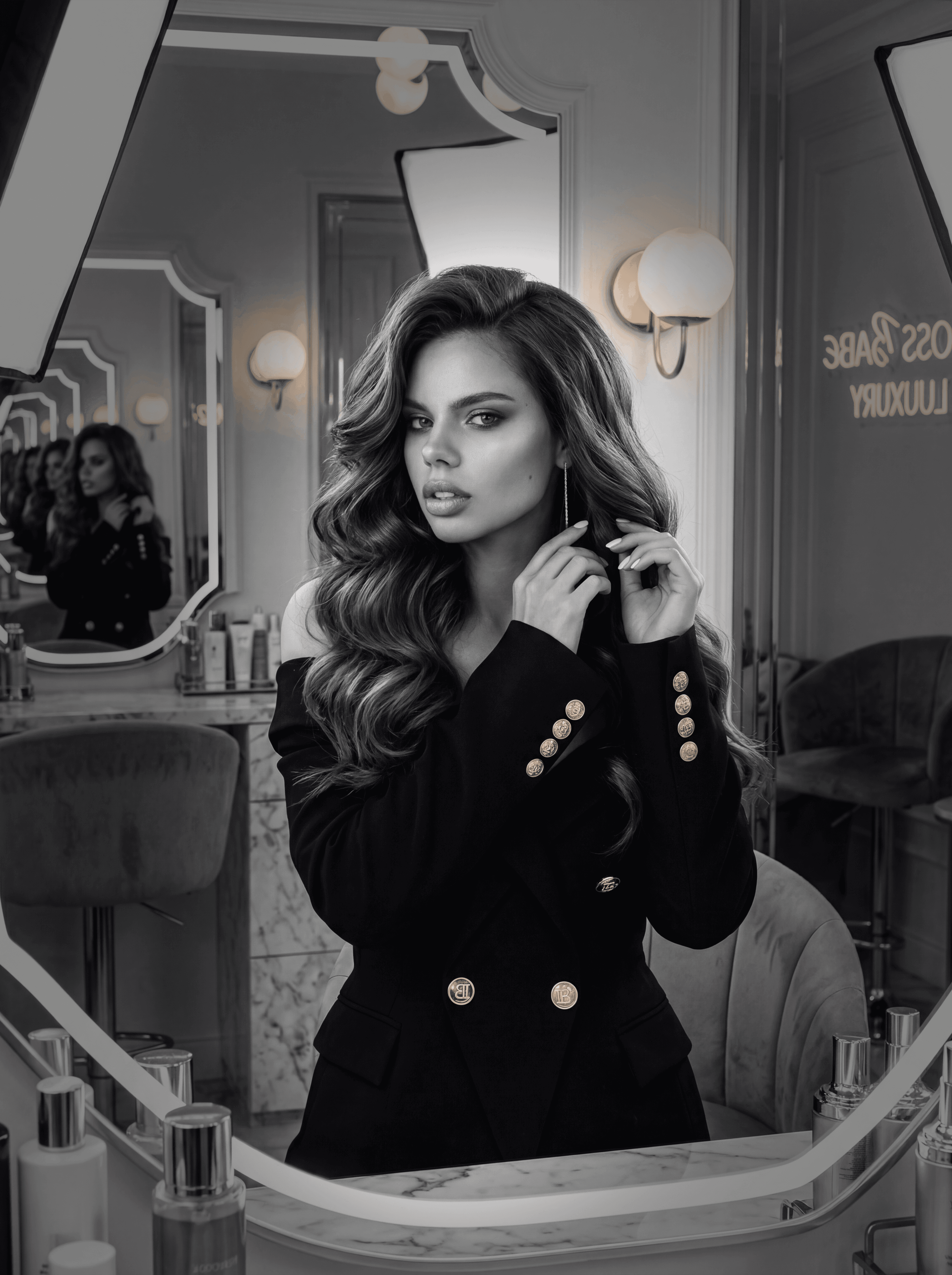
Every stylist has had this conversation. A client sits down, pulls up a photo of someone with gorgeous hair, and says 'I want this.' And we love that, a reference photo tells us so much about what you're drawn to. But the honest truth is that the exact same cut will look completely different on two different people, because a haircut doesn't exist in isolation. It frames a face. The real skill isn't copying the photo; it's understanding why that cut works on that person and translating the principles to you.
The foundation of that translation is face shape. Once you understand the basic idea, you'll start to see why some cuts have always suited you and others never quite worked, and you'll have far better conversations with your stylist.
Before we go further, one quick way to find your own shape: pull your hair back off your face, look straight into a mirror, and trace the outline of your face. Notice where it's widest, how your jaw is shaped, and whether your face is longer than it is wide or roughly equal. You don't need to be precise, and many people are a blend of two shapes, which is completely normal. The point isn't to slot yourself into a rigid box; it's to understand your proportions well enough to know which direction a cut should push them. With that in mind, here's how the thinking plays out across the common shapes.
The one principle behind all of it
Almost all face-shape advice comes down to a single idea: the goal is generally to create the illusion of an oval. The oval is considered the most balanced face shape because it's longer than it is wide, with a gently rounded jaw and forehead. So if your face is rounder, the right cut adds length and reduces width. If it's longer, the right cut adds width and reduces length. If it's very angular, the right cut softens. That's the whole framework. Everything else is detail.
Two tools do almost all the work: where the volume sits, and where the layers and length fall. Volume widens; length lengthens. A stylist is constantly placing both to balance your proportions. Here's how that plays out across the common face shapes.
Round faces
A round face has soft, curved lines with similar width and length and full cheeks. The goal is to add the illusion of length and slim the appearance of width, so you want height and verticality, not width at the cheeks.
- Lean into: long layers, styles with volume at the crown, side-swept fringes, and length that falls below the chin to draw the eye downward.
- Be cautious with: blunt bobs that hit at the cheekbone, heavy straight-across fringes, and one-length styles that add width at the widest part of the face.
A long bob (a 'lob') that sits below the chin with soft layers is a reliable winner, it elongates without flattening.
Square faces
A square face has a strong, angular jaw with roughly equal width at the forehead and jaw. There's nothing to 'fix' here, strong jaws are striking, but if you want to soften the angularity, the goal is to introduce curves and movement.
- Lean into: soft layers, waves and curls, side parts, and length that falls past the jaw to soften the corners.
- Be cautious with: very blunt, sharp lines that echo and emphasise the angular jaw, and a heavy fringe with a hard horizontal edge.
Texture is your friend with a square face, anything that adds softness and movement counterbalances the strong bone structure beautifully.
Long / oblong faces
A long face is noticeably longer than it is wide. Here the goal flips: you want to add the illusion of width and avoid anything that elongates further.
- Lean into: fringes (which visually shorten the face), waves and curls that add width, and layers that build volume at the sides rather than the crown.
- Be cautious with: very long, straight, one-length hair with a centre part and no fringe, which can drag the face longer, and tall volume at the crown.
A blunt or curtain fringe is often transformative on a long face, it breaks up the vertical length and instantly creates balance.
Heart-shaped faces
A heart-shaped face is wider at the forehead and cheekbones and narrows to a pointed chin. The goal is to balance a wider top with a narrower bottom by adding fullness around the jaw.
- Lean into: cuts with volume and movement around the chin and jaw, like a chin-length bob or layers that start around the jaw; side-swept fringes to soften a wider forehead.
- Be cautious with: lots of volume at the crown (which widens the already-wider top) and very short, blunt cuts that emphasise the narrow chin.
Oval faces
If your face is oval, here's your reward: almost everything suits you, because your proportions are already balanced. That doesn't mean every cut is equally good, it means you have freedom. With an oval face you can choose your cut based on your hair's texture, your lifestyle, and your personal taste rather than around correcting proportions. Lucky you.
Diamond and pear faces
Two shapes get left off most lists but are worth knowing. A diamond face is widest at the cheekbones and narrower at both the forehead and the chin, striking, but the goal is usually to add width at the forehead and soften the cheekbones. Fringes and styles with volume at the temples work beautifully here, while slicked-back styles that expose the full width of the cheekbones are best avoided if you want balance.
A pear (or triangle) face is the opposite of a heart, narrower at the forehead and wider at the jaw. Here the aim is to add volume and width up top to balance a fuller jawline, so layers and volume around the crown and cheekbones help, while heavy, wide styles at the jaw tend to emphasise the very thing you're balancing against. As always, these aren't rules about flaws, strong jaws and dramatic cheekbones are gorgeous features. They're just levers a stylist can pull depending on the look you're after.
The details most face-shape guides miss
Face shape is the big picture, but several smaller features change the calculation, and they're exactly the things a stylist notices that a generic chart never accounts for.
- Your forehead height: a high forehead can be balanced beautifully by a fringe, while a low forehead usually does better with face-framing layers than a heavy fringe.
- Your hairline and any cowlicks: a strong cowlick at the front can make certain fringes nearly impossible to wear, which we'd much rather flag before cutting than after.
- Your neck length: shorter cuts can shorten the look of the neck, while length and layers can elongate it.
- Whether you wear glasses: frames interact with fringes and face-framing pieces, and a good stylist will ask you to keep them on during the consultation.
- Your features' proportions: a strong nose, for instance, is often balanced by volume and movement rather than flat, severe styles.
None of these override face shape, they refine it. They're the reason two people with identical face shapes can suit quite different cuts, and the reason a five-minute conversation with your stylist beats any amount of online quizzes.
Why face shape is only half the story
Here's what a good stylist knows that the internet flowcharts leave out: face shape is the starting point, not the whole answer. Several other factors are just as important, and they're exactly why we want to talk before we cut.
A cut that ignores your hair's natural texture is a cut you'll have to fight every single morning. The best haircut works with what grows out of your head, not against it.
Hair texture and density
Fine hair, thick hair, straight, wavy, curly, and coily hair all behave completely differently, and a cut that's perfect for one is wrong for another. Heavy layering that gives thick hair beautiful movement can leave fine hair looking stringy and sparse. A blunt cut that makes fine hair look dense can make thick hair look like a solid block. Curls shrink and need length and shaping considered differently from straight hair entirely. This is the single most common reason a cut that looked great in the photo doesn't work in real life, the photo's hair texture wasn't yours.
Lifestyle and styling time
A cut that needs twenty minutes of styling to look right is a wonderful thing if you enjoy styling and a daily burden if you don't. We always ask how much time you actually want to spend on your hair, because the most flattering cut in the world is a failure if you'll never style it the way it needs.
Features you want to highlight
Cuts can draw attention to your eyes, your cheekbones, your jawline. A good consultation is partly about which of your features you'd like to bring forward, that's personal, and it's part of why no flowchart can replace a conversation.
The fringe question, settled
No single element changes a face as much as a fringe, and it's where face-shape thinking becomes most practical. A fringe shortens the visual length of the face and draws attention to the eyes, which is why it's so transformative, but the type of fringe has to suit your shape, or it works against you. A long, soft, side-swept or curtain fringe is the most universally flattering because it adds softness without a hard horizontal line; it suits almost everyone, which is exactly why it's been popular for years.
A blunt, straight-across fringe is bolder and best on longer face shapes, where it shortens and balances beautifully, but it can overwhelm a round or small face. Wispy, textured 'bottleneck' fringes split the difference, giving the eye-framing effect with more breathing room. The practical catch nobody mentions: a fringe is a commitment to maintenance. It grows into your eyes within weeks and needs trimming roughly every three to four weeks, many salons offer free fringe trims between cuts, and it's worth asking. If you won't keep up with that, a face-framing layer gives a similar softening effect with far less upkeep.
It's also where your hair's texture really decides things. A blunt fringe on naturally wavy or curly hair will not sit the way it does on the pin-straight model in the photo, it'll spring up and behave completely differently, and pretending otherwise is how people end up unhappy. A good stylist will tell you honestly whether the fringe you want will work with the hair you actually have.
How to have a great consultation
So bring the photo, absolutely bring the photo. But come ready to talk about more than the image. Here's how to get the most from your appointment:
- Bring a few reference photos, including ones you DON'T like, knowing what to avoid is as useful as knowing what you want.
- Be honest about how much time you spend (and want to spend) styling each morning.
- Mention what's worked and what hasn't with past cuts.
- Tell us about your hair's quirks, the cowlick, the part that won't sit, the side that's thicker.
- Trust your stylist to translate. If we suggest adjusting your reference, it's because we're adapting it to suit you, not overriding you.
The best haircut isn't the one trending this month or the one on the model in the photo. It's the one designed around your face, your hair, and your life, a cut that looks intentional, feels like you, and is easy to live with. So bring your inspiration, but come ready to collaborate, and trust a good stylist to adapt it into something that genuinely suits you rather than something you'll be fighting in the mirror every morning. That's what we're really doing when we pause before picking up the scissors: not copying a picture, but building something that's genuinely yours.
Ready to talk it through with us?
Book an Appointment